Black Friday and Cyber Monday Marketing Strategies in 2026 (Last Minute Checklist)
Black Friday and Cyber Monday are just around the corner. For many businesses, these shopping events mark the start of the biggest sales period of the year. But shoppers now start researching deals earlier, comparing prices, and discovering products across websites and social media.
That means simply offering a discount is not enough. You need a well-planned Black Friday and Cyber Monday marketing strategy that covers your website, email campaigns, social media, paid ads, and customer experience.
Whether this is your first BFCM campaign or you have run one before, a clear checklist can help you avoid last-minute mistakes. In this guide, we’ll share practical Black Friday and Cyber Monday marketing strategies you can use in 2026, along with a last-minute checklist to help you get everything ready.
So, let's get started!
Black Friday and Cyber Monday – How it All Started
Before getting into Black Friday and Cyber Monday marketing strategies, let's quickly look at where these shopping events came from.
What Is Black Friday?
Black Friday is the Friday after Thanksgiving in the United States. Its name is generally traced to Philadelphia in the 1950s and 1960s, where police used the term to describe the heavy traffic, crowds, and other problems caused by shoppers and visitors.
The popular story that Black Friday got its name because retailers move from “red” to “black” in their accounting came later as a retail-friendly explanation. It was not the original reason for the name.
Thanksgiving Day parades did play a role in the growth of holiday shopping. Macy's held its first Thanksgiving Day parade in 1924, and department-store parades helped connect Thanksgiving with the Christmas shopping season. However, the Macy's parade was not what created the term “Black Friday.”
Over time, Black Friday grew from a U.S. retail event into a major shopping period used by retailers in many countries. Today, many businesses start their promotions before Black Friday and continue them through Cyber Monday.
In 2026, this Black Friday will be on 27th November. Cyber Monday will follow on Monday, November 30.
What Is Cyber Monday?
Cyber Monday takes place on the Monday after Thanksgiving. It was introduced in 2005 as a way to highlight online shopping and has since become a major eCommerce sales event. The term was created by Shop.org, the digital retail division of the National Retail Federation, and was promoted through a 2005 press release.
Today, the difference between Black Friday and Cyber Monday is less strict than it used to be. Many brands now run promotions across the entire Thanksgiving-to-Cyber-Monday period instead of treating the two days as completely separate events.
That means you should think about BFCM as a campaign period, not just two individual dates. Recent data supports this shift toward a longer shopping period. Adobe reported that Black Friday online sales grew faster than Cyber Monday in 2025, as shoppers responded to earlier deals.
For 2026, Adobe expects Black Friday to grow 9.2% to $12.9 billion in U.S. online sales, while Cyber Monday is expected to reach $15.1 billion. NRF's 2025 holiday data also found that Black Friday remained the most popular shopping day, with 85.7 million online shoppers, while Cyber Monday attracted 75.9 million online shoppers.
Cyber Monday & Black Friday Marketing Strategies for the Holiday Season
Following this checklist will help you create the perfect marketing campaign for Black Friday and Cyber Monday. We have prepared this checklist after some thorough research, and also added our own experience.
- Optimize Your Website to Handle the Extra Traffic
- Offer Attractive Discounts in An Exceptional Way
- Send Emails with Compelling Subject Lines
- Place and Schedule Your Theme-based Pop-ups
- Use the Social Platform Wisely to Increase Social Selling
- Leverage The Power of Remarketing
- Utilize Proven Strategies for Paid Ads
- Try Early Access or Last Minute Discounts
- Offer Free Shipping for Your Customers
- Make Your Customer's Experience Worthwhile
- Prevent Shopping Cart Abandonment
- Focus on Customer Retention After BFCM
Now let's get into the details!
1. Make Sure Your Website is Optimized & Ready to Handle the Extra Traffic
We have mentioned before, at the time of Black Friday and Cyber Monday you will see a spike in traffic. A lot of customers will visit your site who are potential buyers. So, you should make sure they have a pleasant experience while visiting your store.
You need to be ready to handle the extra traffic without hampering the normal speed, quality of your website.
Studies show that users don't like it if the website takes more than 5 seconds to load. However, another study shows that if your website loads within 1 second, then you can enjoy a 32% more conversion rate.
Here are a few tips to increase your website loading speed,
- Choose a Quality Web Hosting
- Keep Your Site Up to Date
- Choose a Speed Optimized Theme
- Optimize Your Database
- Use Optimized Images
- Minimize the HTML, CSS, and JavaScript files on your site.
If you can follow this list, then we can safely say that you won't have any issues regarding your website's loading speed.
2. Offer Attractive Discounts – Think Outside of the Box
Yes, Cyber Monday and Black Friday are all about discounts and deals. That doesn't mean you can offer sitewide discounts. It is not the smartest idea.
You need to create deals that are specific for Black Friday and Cyber Monday. You can create specific pages for products in the sales section for this shopping season. Also, you may include the products that haven't been selling much.
Offering the BOGO ( Buy One Get One ) deal for those products is a smart way to reduce your inventory as well.
You can offer special rewards for customers. Like, if they purchase above $100 they will get an extra 15% discount. You can also increase the average order value of each customer by offering free gifts or bonuses along with the purchase.
Follow the trend of the last year if you are confused about which items to give a discount to.
3. Make Your Email Campaigns Stand Out on BFCM
This is an important part of your Cyber Monday and Black Friday marketing strategies. Having a solid email marketing campaign is a must for any business. However, it becomes essential in this timeframe.
Because this is a great time to capture leads and build your email list. So, customize your email according to the theme of Black Friday and Cyber Monday. Also, personalize your email content that can lead up to six times higher transaction rates.
People are usually looking for the best prices out of all the deals. So, you should highlight your offer and also mention how much they can save if they buy products from your store. Adding a countdown timer can also be a fruitful strategy as customers tend to react to time-sensitive deals.
Moreover, offering incentives, early access can help customers to sign-up. Make sure to add a powerful CTA and exciting graphics.
If you are a WordPress user, then weMail is a great solution for your to build your email list. You can create amazing campaigns and also help manage your subscribers more efficiently.
After building your email list, now it is time to send out emails. However, it will be useless if users don't open your emails. In 2026, some email providers processed over 5.8 billion emails on Black Friday alone, so you’ll need to work hard to stand out!
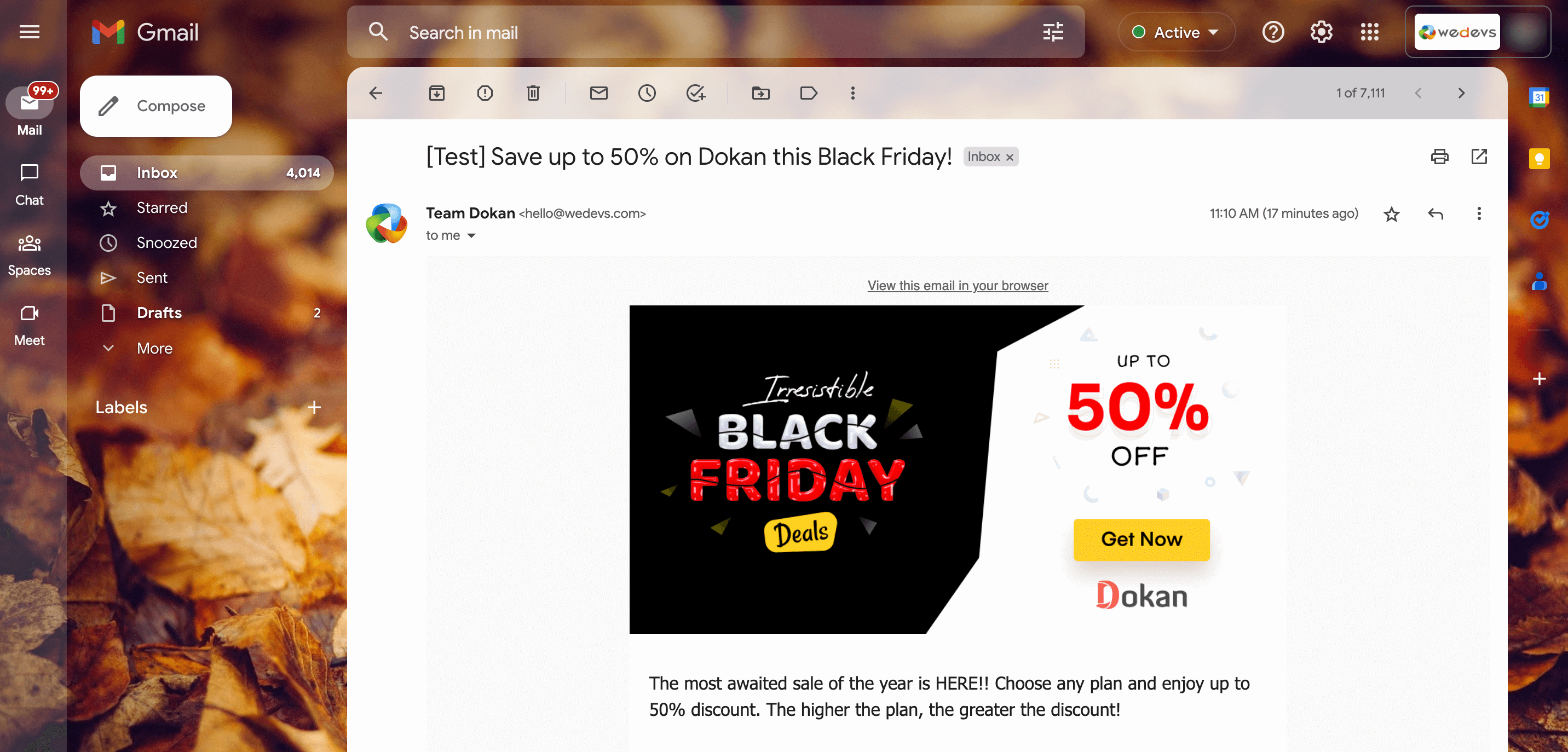
You need to create a subject line that stimulates the user's interest to open your emails. You need to offer something different rather than plain ‘We are giving X% discount.'
For example, if you use the recipient's name in the subject line, then you can increase the open rate by 22%. You will see a similar type of result if you can add urgency or an exclusive offer in your subject line.
Here are some popular subject lines you can take inspiration from,
- Flex your power-shopping muscles this Black Friday
- The countdown to Cyber Monday is NOW ON
- Your Cyber Monday survival guide
- Top gifts this BFCM weekend
- Psssst… This sale is a secret!
- Why wait until Black Friday? Access our sale early!
You can use these well-proven subject lines, or you can put your own spin on them and use them on your Cyber Monday and Black Friday emails.
4. Place and Schedule Your Pop-ups
Pop-ups are far more than just collecting emails. You can use pop-ups to let your customers know about your BFCM deals, reduce abandoned carts, tell them about your shipping options, etc.
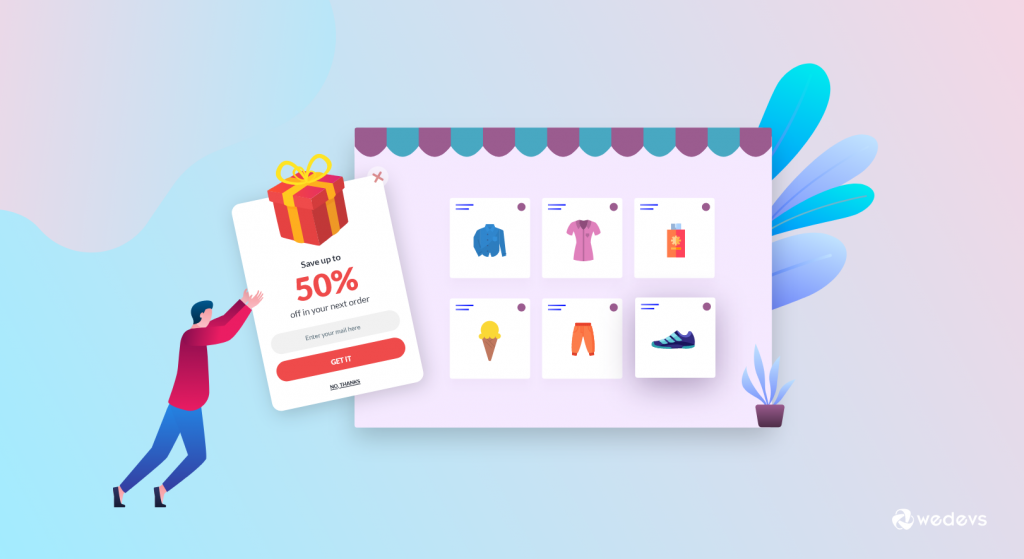
Carefully targeted pop-ups can elevate the user's experience and also increase your conversion rate. Online retailers who have been doing Black Friday and Cyber Monday deals will tell you that having the right pop-ups at the right time is a great way to encourage specific visitor behavior, from upselling to subscribing.
Also, pop-ups are a great way to create urgency. You can add a live countdown timer to let your customers know exactly how long they have left before the close of the sale.
5. Use the Social Platform Wisely & Utilize Social Selling
If we need to tell you that you need to use social channels to promote your Black Friday and Cyber Monday sales in 20245, then you are way behind.
Using social channels to promote your deals should be a key part of your Cyber Monday and Black Friday marketing strategies. This is a no-brainer.
Use Instagram, Facebook, Twitter, Reddit, LinkedIn, etc. Run ads on Facebook, make a video on TikTok, post a photo on Instagram, and use a graphic on Twitter. However, many online shop owners miss the importance of social selling.
If you can connect your online store to your social channels, then you can reduce any friction you may have in your online shopping experience.
Also Read: Strategies to Launch A Social Media Holiday Marketing Campaign.
6. Make Good Use of Remarketing
The basic mistake most new online stores make is that they forget about their existing users and only focus on new users. That is not smart.
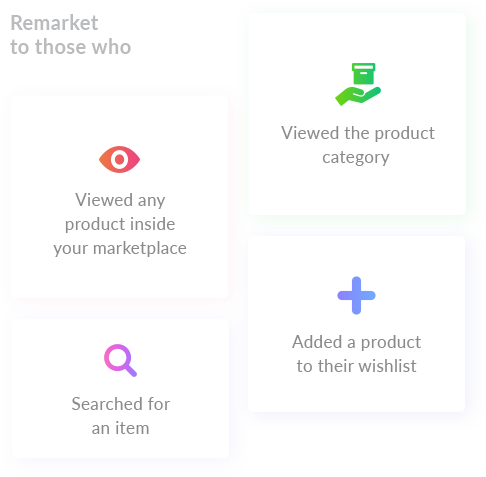
Existing customers are easy to reach, and you can sell your products to them rather than the new ones. They are more likely to recognize your brand and be more receptive to your BFCM ads.
7. Don't Experiment with Paid Ads, Go for Proven Strategies
Organic traffic may be the best way to generate revenue, but you can't forget about paid ads. They can be invaluable for Black Friday and Cyber Monday marketing.
And this shopping season is not the best time to experiment with your PPC ( Pay Per Click ). Instead of strategic planning, you can receive a quick boost in online traffic.
Around 79% of brands that use PPC claim it’s a “huge driver” for their success, and with plenty of tailoring options, you can easily get your paid ads in front of your target audience. Your paid ads should create urgency, and you should use copy smartly.
However, you need to set up ad tracking in order to know how it is performing. Google Analytics Dashboard is a great option to track your ads.
But if you are using a WordPress site and want to get data easily, then we suggest you use WooCommerce Conversion Tracking. This tool will help you get all the data on your WordPress dashboard, and you will be able to track all your ads easily.
8. Try Early Access or Last Minute Discounts
People have a lot of options in the Black Friday and Cyber Monday shopping season. So, some of them don't like to make spur-of-the-moment purchases. For them, you can offer some last-minute deals so that they can come back and redeem those offers.
In 2026, 52% of shoppers took advantage of early bird savings, and 38% bought items in the week leading up to Thanksgiving. So, offering early access is not a bad idea as well. It will also give you an opportunity to run your campaign a little longer.

So, these are the main points you should consider before going live with your Black Friday and Cyber Monday campaign. Remember, Cyber Monday comes right after Black Friday. With strategic planning, you can take full advantage of both of these shopping days and generate great revenue.
However, you now know what should be your Cyber Monday and Black Friday marketing strategies. But if you are not careful, you can make some mistakes that may cost you. We are going to list them out for you, and hopefully, you can avoid them.
9. Offer Free Shipping
Offering free shipping can affect the 49% conversion rate. Especially at this time. So as a shop owner, you can offer free shipping and promote on social media, emails, and ads that have links to your landing page.

However, if you are selling expensive products, then you can set a limited shipping rate on specific orders. You need to set a time limit on the offer; otherwise, it will lose its credibility.
10. Make Your Customer's Experience Worthwhile
Last but not least, don’t go overboard. You shouldn't do too much that throws off the customers. Sometimes, keeping it normal and doing the basics right is the way to go.
Usually on Black Friday and Cyber Monday, people visit online stores more than normal. So it is your job to elevate the customer experience and make sure they can easily find what they are looking for and complete the purchase.
Read Also: Top 10 Christmas Marketing Ideas to Boost Your Sales.
11. Prevent Shopping Cart Abandonment
The global cart abandonment rate back in 2026 on Black Friday itself was lower than average, at almost 78%. This indicates a perfect opportunity to further prevent abandoned carts during this period.
That is why you need to implement an abandoned cart strategy. Here is what you can do to prevent abandoned carts-
- Send timely abandoned cart emails.
- Offer a discount or incentive to complete the purchase.
- Highlight the benefits of completing the purchase.
- Use urgency and scarcity tactics.
- Personalize your abandoned cart emails.
- Make it easy to complete the purchase.
- Use retargeting ads.
12. Focus on Customer Retention After BFCM
Most brands chase new buyers during BFCM and then forget about them. That’s a big mistake. The real profit often comes after the sale.
Use the post-BFCM period to turn one-time buyers into loyal customers. Send personalized thank-you emails. Offer small rewards, loyalty points, or early access to your next big sale. You can also share product care tips, tutorials, or user stories to keep them engaged.
It’s not just about selling again. It’s about showing that you care even after the purchase. When customers feel valued, they’ll keep coming back long after BFCM ends.
Cyber Monday & Black Friday Marketing Mistakes You Should Avoid
As both Black Friday and Cyber Monday possess a big opportunity to earn a profit, online store owners sometimes tend to get carried away and make some silly mistakes.
But this is the time they need to keep a calm head and plan their way out. Otherwise, they will end up incurring a loss instead of earning a profit. Here are some mistakes you should avoid while you are planning Cyber Monday and Black Friday marketing strategies:
- Focusing only on the size of the discount
- Using unclear or complicated offers
- Ignoring mobile shoppers
- Launching emails or ads too late
- Sending the same message to every customer
- Forgetting to test checkout and payment methods
- Hiding shipping costs until the final step
- Using fake urgency or misleading countdown timers
- Promoting products that are out of stock
- Failing to monitor campaign performance
- Ignoring existing customers while chasing new ones
- Making major website changes immediately before the campaign
These are the mistakes you need to avoid while you are making strategies for Black Friday and Cyber Monday. Hopefully, this will help you conduct a successful campaign on both of these days.
Read Also: Why eCommerce Businesses Fail & How to Resolve Them.
Last Minute Checklist for Black Friday and Cyber Monday Sales
- Test website speed and mobile responsiveness
- Ensure payment gateways are working
- Check inventory and stock levels
- Schedule emails and push notifications
- Set up exit-intent popups
- Confirm discount codes and promotions
- Double-check theme-based popups and banners
- Review social media posts and ads
- Activate remarketing campaigns
- Test checkout and cart functionality
- Prepare customer support for high traffic
- Monitor analytics and live traffic dashboards
- Ensure free shipping settings are active
- Back up website and critical data
- Finalize early access or last-minute offers
Best Black Friday & Cyber Monday Deals You Should Check
After Halloween, Black Friday and Cyber Monday are considered the biggest shopping seasons leading up to Christmas. Along with other industries, the WordPress community also celebrates by giving some attractive deals and discounts on all of their products.
You will see that the number of deals on Black Friday and Cyber Monday is much bigger than on Halloween. Many companies consider these two occasions to be more important than Halloween. That is why they skip Halloween and start their BFCM campaign early.
As the number of deals increases, so does the confusion of people as to where to find the best deals. That is why every year we prepare the list of the best Cyber Monday and Black Friday deals in the WordPress industry. Check out all the exciting deals right here! ⤵️
Black Friday Marketing Strategies – Common FAQs
1. When should I start planning my BFCM campaign?
Start at least 4–6 weeks before Black Friday. This gives you time to test your site’s performance, prepare ad creatives, and warm up your audience with teasers or early access offers.
2. What type of discounts work best during BFCM?
Tiered discounts and bundled offers usually perform better than flat rates. For example, “Buy 2, get 1 free” or “Extra 10% off for repeat customers” creates urgency and boosts average order value.
3. How can I stand out when every brand is running sales?
Be creative with your offers. Try limited-time flash sales, personalized recommendations, or gamified deals like spin-to-win or mystery boxes. Also, use short videos and live streams to grab attention fast.
4. What’s the best way to reduce cart abandonment during BFCM?
Simplify the checkout process. Offer guest checkout, multiple payment options, and clear shipping info. You can also use exit-intent pop-ups or send cart reminder emails to bring shoppers back.
5. What should I do after BFCM to keep sales coming?
Follow up with post-sale emails. Thank your customers, offer loyalty points, or give exclusive access to future discounts. Build relationships now so they return for future sales.
Adopt a Suitable Strategy to Launch Successful Black Friday & Cyber Monday Campaigns
When you are planning Cyber Monday and Black Friday marketing strategies, it is essential to consider your customers at every step. Remember, your Black Friday and Cyber Monday customers are not one-time customers.
Hopefully, our strategies will help you get a strong starting point. However, to truly achieve success in this period, you need to put in a lot of effort. Customers have already shifted their way of interacting with brands. So, if you are not careful, you will not only lose a huge amount of revenue but also harm the reputation of your brand.
With proper planning and strategy, you can create a long-lasting relationship with your customers. Who knows, with an outstanding campaign, you can also gain a loyal customer base and create a community.
Like our blogs? Subscribe to our newsletters and receive daily updates. We don't spam!

